Tuesday, 28 June 2011

The Gulf of Patras to Trizonia


The winds looked promising so we said our goodbyes to ASTAKOS and set sail for Missalonghi, our first stop in the Gulf of Patras on the Eastward Journey to The Aegean.


Disappointingly once we were on our way the winds dropped and it was like a millpond.  We did hoist the sails for part of the journey passing many islets on our way south and eventually turned east into The Gulf of Patras heading for Missalonghi, a large town built on salt marshes with a dramatic backdrop of mountains.


We approached the marina via a canal with colourful fishing shacks on either side. 


Having secured a good berth for the night the guys lit up the barbecue and we dined on  traditional fare of Souvlaki whilst haunting Greek music drifted over the water from a distant wedding party.


MISSALONGHI TO PATRAS

Alan had originally planned to sail to Trizonia but the famous Westerly Winds, which were supposed to help us on this leg, turned into strong Easterlies eventually achieving gale force with 37 knots of wind.  It was a slow uncomfortable trip, the waves pounding against the bow, as the boat motored making an average of only 2-3 knots, however we all felt safe in the central cockpit even if the helmsmen did have frequent showers of saltwater.  Six long hours later we decided to pull in at Patras Marina, once tied up we desalted the boat and ourselves with long showers.


Patras is the third largest town in Greece, a bit of a concrete grid but it did have some character with lots of wonderful old fashioned shops (often no more than windowless corridors lined by dozens of drawers) and a fairly modern central area which seemed to be patronized by some of the 40,000 students who study here.  Greek Ironmongeries are a great favourite of mine - classic one on the right.


The marina area was quite smart, a parade of up-market cafes and bars with a feel of the Cote D’Azur.


Our stay turned into 3 nights as the winds continued to gust with huge white caps racing down the Gulf, we felt fortunate to be safely tucked up in the Marina. One day we climbed up to an old Citadel which looked down over the town from a steep hill.


– 193 steps later we reviewed the site and were rather disappointed in the ruins however the view was spectacular.


On roaming further we became aware of cordoned off excavations – we later discovered that this whole area had been the site of an important Roman theatre and sports complex.

PATRAS TO TRIZONIA


Finally we awoke to a beautiful day of ‘milky’ blues and soft winds and set forth to travel under the Rion-Andirrion 2,252 m. long suspension bridge (second only in length to the Millau Viaduct in France).   The bridge dramatically improves access to and from the Peloponese which  previously could be reached only by ferry or via the Isthmus of Corinth at its extreme east end.


It’s hugely impressive; men working on the bridge looked the size of tiny ants and put it all the more in perspective.   There’s a strict procedure for going under the bridge – we had to inform the bridge master of the boat’s name and height before getting the go ahead.  

Once safely through we hoisted the sails and with the wind from behind we were able to achieve a good ‘gull-wing’ setting and enjoyed a beautiful sail to the island of Trizonia.  


Trizoni lies a short distance from the mainland in the North.  It’s a quiet cluster of houses and a couple of hotels, a very unspoilt relaxing little place.
  

We ambled along some of the coastline......


and ended up having a drink at a taverna in the small local port watching the last rays of sun on the fishing boats

TRIZONIA TO ITEA

With gusts of 30-35 knots we sailed with a couple of reefs in the foresail and still achieved an average of 7 knots, the weather was magical helping to make this sail of 21 miles the best so far.   I noticed that the mountains were looking more barren and arid than those on the Western Coast.  

At Itea we secured a good alongside berth and once the boat was tied up we sped off to the bus terminal to get information for our trip to Delphi the next day.  


Saturday, 25 June 2011

Leaving The Ionian Islands


On 1 June we finally left Lefkas town, our base since buying Moody B’Lou last year.   It was sad to leave this community, everyone had been so supportive and generous.  Saying farewell to the island too was a wrench, with its sweep of steep green mountains descending to the sea.  

South of the Lefkas Canal we entered the Inland Sea, so called because of the 360 degree view of mainland and islands.   As usual it was panorama of myriad blues and greens, it always takes my breath away…….


We made for One Tree Bay, a quiet inlet on the mainland and a favourite lunch-time anchorage.   Here we all had a swim in pristine waters and a leisurely lunch.


Later we continued our sail down the East Coast of Lefkas passing by the islands of Meganissi and Skopelos.


Our first night was spent in RUEDA BAY on the South Coast of Lefkas.  It’s a large quiet bay with a sprinkling of holiday apartments and tavernas and we were able to find a safe anchorage about a 100 metres from the beach, once more the waters were so clear we could see our anchor on the sandy seabed.  Moody B'Lou is first boat on left.


The cliff face at Rueda Bay
The bay is lined on one side by incredible cliffs which catch the evening light.


We enjoyed the solitude and took advantage of the barmy evening by christening the new barbecue.  The boys, aided by a glass or two of vino, cooked a plump chicken that we all enjoyed and the new barbecue was declared ‘fit for use’.


The following morning Gerry fired up Scooter and we motored off to the dingy dock to enjoy the first morning walk of ‘BISSETT TOURS’  an ideal opportunity to find our ‘land legs’ and also explore.  Everything was very quiet, we felt sorry for the locals, who are so dependent on tourism, however we enjoyed the walk with occasional views of turquoise seas and Moody B’Lou.

Goodbye Rueda Bay


RUEDA BAY TO KIONI (Ithaca) 

Late morning we set off for Kioni, NE of Ithaca.  There was a good NW wind but the main sail stubbornly refused to unfurl from the mast, fortunately we managed to sail  with just the foresail.   Kioni, marked by three old windmills on a headland, eventually appeared and we motored into the small harbour.  Here we had to undergo the manoeuvres of the ‘continental mooring system’ i.e. you drop the anchor fifty yards or so out from the quay then reverse to the quayside ‘stern to’ in order to tie up.   This was Lynne and Gerry’s first experience and as usual it was all a bit of a song and dance.   Neighbouring boat owners get very uptight about their lines being crossed so you usually have plenty of spectators.  


Kioni is a dramatic little harbour with lots of brightly coloured houses scattered on the surrounding hillside and enticing tavernas on the quayside.   


After our trials with the main sail and the mooring performance, Alan’s idea of a late lunch at one of the local restaurants was readily endorsed – a meze or two with a glass of wine fitted the bill perfectly.

And there was always someone to eat the leftovers........


UP THE MAST

The next day Alan was anxious to sort out the problem with the main sail.  Thankfully the morning was calm and Gerry bravely agreed to haul Alan up the 20 meter mast in the bosun’s seat (a canvas seat attached to strong rope) – Lynne and I stood by, hardly daring to look up apart from taking a photo or two……….  Alan at top of mast in right hand photo


The mission however was successful as Alan managed to manually pull out the creases which had impeded the unfurling, he looked so very small right at the top of the mast and I was glad to see him ‘on earth’ once more.  

Thanks to Gerry, the winch man......


         Farewell to KIONI


With repairs completed we departed for EUFIMIA, sailing down the east coast of Ithaca, around the south tip and then up the Ithaca Channel to the island of CEPHALLONIA, famous for the story of Captain Correlli’s Mandolin (which is based on a true story).    


We moored ‘stern to’ at the quayside with the luxuries of electricity and water connections.  Another quiet resort, we had remembered it as such a busy hub last year.   


Cephallonia itself, is the largest of the Ionian Islands with soaring rugged mountains (many of which are covered in wind generators) and lush pine forests. 


Early the next morning Bissett tours set off on another walk passing through the small village into fields of wild flowers with a backdrop of steep mountains. 


........ the beauty inspired a tango by Mr and Mrs Bissett


We farewelled the IONIAN ISLANDS as we sailed back down the Ithaca Channel on our way to Astakos on the mainland.


Another perfect day as we sailed down the Ithaca Channel with all 3 sails performing well – foresail, stay sail and the main sail.  It was a long journey so lunch was ‘on the go’, but we did have a quick look at ‘One House Bay’ on Atoko – another idyllic anchorage of clear turquoise waters.  Finally we motored into Astakos, a quaint mainland resort that we had enjoyed last year.


One of the local taverna owners recognised Alan and rushed out to give him 3 large kisses and a handshake – (Alan must have left a very large tip last year!).  Once the boat was secured we took a leisurely walk – I returned to an ironmongery to add to my goat bell collection and it became a musical event as we tried them all out for sound!   


We returned to our friendly taverna owner for supper.   The memory of the extremely large platter of seafood followed by Sea Bream and very full stomachs will remain with us for some time…..


The next morning we were woken by dozens of church bells, it was Sunday and they did sound wonderful. Taking advantage of the early wake-up call, we walked along the promenade.............


admiring dozens of small quirky, much loved fishing boats.   


We continued on a steep road out of the town that ended at a monastery built out on a peaceful woodland promontory; stopping at the gates we listened to the chanting of the monks and enjoyed a special moment………..


The winds looked promising so we said our goodbyes to Astakos and set sail for the next part of the adventure sailing south and then east into The Gulf of Patras.

Saturday, 18 June 2011

First Sail of the 2011 Season - North to Paxos

The first trip of the Summer was a short excursion north to Paxos (south of Corfu).  The main reason for the trip was to meet up with our old walking friend John Storr who we hadn’t seen for over twenty years.  


Leaving Lefkas Marina (Moody B'Lou's solar panels in foreground


Lefkas Canal Swing Bridge


On a beautiful Summer’s morning we left the marina, headed north up the Lefkas Canal and negotiated the famous Swing Bridge – it moves around on a 90 degree angle once every hour to let boats through.   The Canal cuts through salt marshes and technically makes Lefkas an island.  Once past the bridge we quickly motored by Santa Maura an old fort, which was built in the Middle Ages and later used by sundry invaders. 


We arrived at Anti Paxos in time for lunch and stopped in a quiet little bay (a first outing for our new Jambo anchor).   We all marvelled at the clear turquoise waters – the anchor was easy to spot many metres below.   Later the winds became stronger and we were able to sail up the East Coast of Paxos which looked lushly green.  Boys had a great time adjusting the sails for a 'gullwing' - making the most of a wind coming from behind us.   


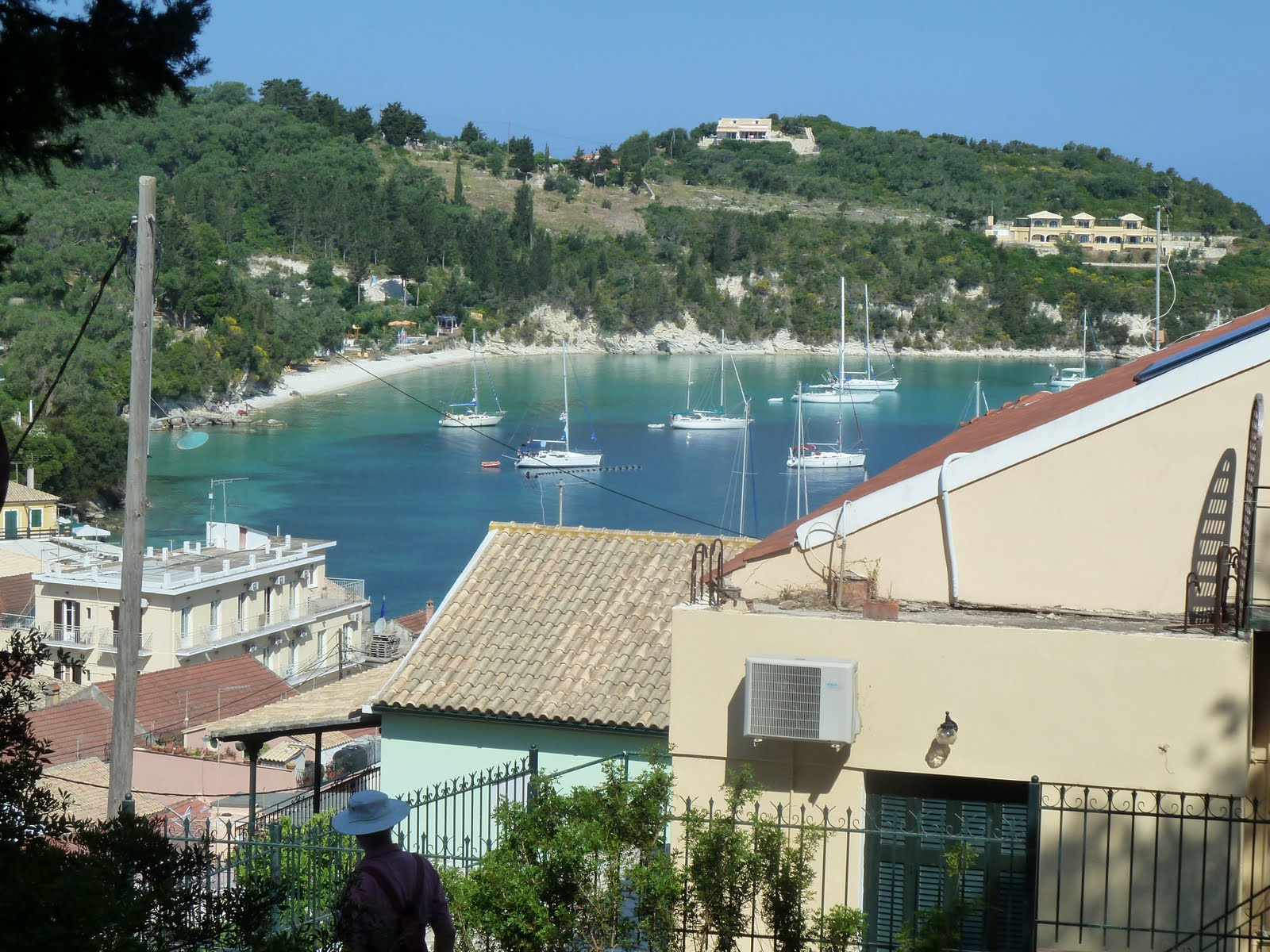
Port of Lakka N. Paxos

One of many fishing boats in bay

Twenty years on......... John hadn't changed a bit!

Our friend, John, was staying in Lakka, a small natural harbour at the Northern End of Paxos, he's a regular visitor enjoying all the walks and bird life.   We all met up for supper – another surreal moment – especially since John hadn’t changed a bit!   We always loved his sense of humour and now he was able to show us Paxos through his eyes. We in turn planned to show John a new perspective of Paxos, as a sail around the island was arranged for the following day.   But first, supper in the village square, always an excellent place to people watch  (children playing, grandparents sipping coffee whilst parents ate and caroused). 

John bravely joined us the next day as we sailed anti-clockwise around the island, skirting the Western rugged side with huge cliffs abutting the sea.   After visiting our little bay off Anti Paxos for lunch we once more sailed up the East Coast noting how the gentle indented coast differed to the wild Western side.   The day concluded with a visit to another taverna for supper with great views over the harbour. 


John was due to fly back to UK the next day but directed us to a gorgeous walk through vineyards and woodland pathways, with profusions of wild flowers, leading to a small pebbly beach – (thank you John, that steep hill out of the village won’t be forgotten!).  Again we noticed how crystal clear the waters were – it all looked so inviting.  


Wednesday, 8 June 2011

Meteora - not a sailing adventure

I left Alan to complete the finishing touches to Moody B'Lou and flew off to Venice and UK for a couple of weeks.  The fortnight was wonderfully hectic, crammed full of sightseeing and catching up with friends.  On my return the boat was looking resplendent with all wooden surfaces rubbed back, canvas awnings transformed to navy, the decks all scrubbed and polished, a new fibre glass passerelle (plank to shore), plus sails set ready to leave.  I must go away more often!


However, we had to pick up our first crew and this we had arranged to do in the mountainous terrain of Meteora about a 4-hour drive NE of Lefkas.  It was an exciting journey as we drove up around sharp hairpin bends into mountains which reminded us of the Pyrenees.  We arrived at our destination just in time to meet Lynne and Gerry Bissett off the train from Athens.


Meteora is famous for its rocky 'monoliths' - these alone would have been worth a special visit.   However many centuries ago religious hermits were drawn here.  Over the years they joined forces (creating a religious orders) and migrated to the tops of the tallest rocks to build safe refuges from unfriendly invaders.  During the centuries the monks created beautiful monasteries carved out of the rocks, they also became the 'guardians' of Greek culture.   Today there are just 6 monasteries operating - they look spectacular.


Monastery of the Great Meteoron (Transfiguration), oldest and largest of the monasteries.  All the monastery chapels were quite small and totally covered in colourful religious murals  (navy, reds and golds predominated) - depicting the grisly death of different martyrs as well as Christ's life.


Lynne and Gerry in a monastery loading bay.  Everything was raised in the 'net', today this is a metal cage (to left of Gerry).  It's almost unbelievable that these monasteries were created by hauling up all necessary worldly goods, both to build and then sustain the monasteries.  We climbed many hundreds of steps (only built about 50 years ago) to visit the monastery interiors with the added bonus of spectacular views.

View from the Monastery